
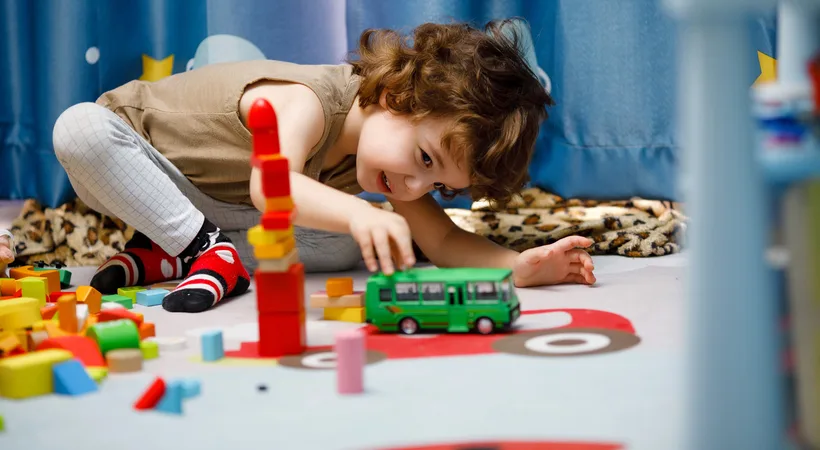
A curious toddler explores stacking blocks and toy vehicles during fun Toddler Learning Games that support creativity, coordination, and early problem-solving skills.
As a parent, you’ve likely watched your toddler transform from a bumbling crawler into a curious explorer in what feels like a heartbeat. In 2026, we know more than ever that these early years aren’t just about “passing time”—they are the most critical window for brain development.
The secret to unlocking this potential? Toddler learning games.
But with thousands of toys, apps, and “educational” activities flooding the market, how do you choose what actually helps your child grow? This comprehensive guide dives deep into the science of play, the best types of games for every developmental stage, and how to balance digital tools with hands-on fun.
Table of Contents
Why Toddler Learning Games Are a Development Powerhouse
The toddler brain is a sponge, forming up to one million new neural connections every second. Play is the “work” of a toddler, and learning games provide the structure for that work to yield results.
1. Cognitive Growth and Problem Solving
When a toddler tries to fit a square peg into a round hole, they aren’t just playing; they are practicing spatial reasoning and trial-and-error. Cognitive games help children understand cause and effect, improve memory, and build the foundation for early math skills like counting and sorting.
2. Fine and Gross Motor Skills
- Fine Motor: Games involving threading beads, drawing, or using digital “tracing” apps strengthen the small muscles in the hands.
- Gross Motor: Games like “Simon Says” or “Indoor Scavenger Hunts” develop balance, coordination, and large muscle strength.
3. Language and Literacy
Toddlers who engage in word-based games—even simple ones like “I Spy”—tend to have larger vocabularies by age three. Games encourage “serve-and-return” interaction, which is the gold standard for language acquisition.
4. Social-Emotional Intelligence
Games with rules (even simple ones!) teach toddlers about turn-taking, patience, and emotional regulation. Learning how to lose a game of “Memory” is just as important as winning it.
Essential Types of Toddler Learning Games
To give your child a well-rounded start, it’s best to rotate between different categories of play. Here are the four pillars of toddler learning:
Sensory Play Games
Sensory games engage a child’s senses (touch, smell, sight, sound, taste) to help them explore the world.
- The Rice Bin Hunt: Fill a bin with dyed rice and hide small plastic animals inside. Ask your toddler to find the “red lion” or “the blue bird.”
- Texture Matching: Gather scraps of fabric (silk, denim, wool) and have your toddler match the pairs with their eyes closed.
Cognitive & Logic Games
These games focus on the “how” and “why” of objects.
- Color Sorting: Use colored construction paper and household objects. Have your child place the blue spoon on the blue paper.
- Shape Sorters: Classic for a reason! They teach spatial awareness and geometry basics.
Movement & Physical Games
Get them moving to burn energy and build brain-body connections.
- Animal Walks: Ask them to “Walk like a heavy elephant” or “Hop like a tiny frog.” This builds vocabulary and gross motor control.
- The Tape Maze: Place painter’s tape on the floor in zig-zags. Ask your toddler to walk the line while carrying a “precious cargo” (like a stuffed animal).
Imaginative & Role-Play Games
Role-playing helps toddlers process real-world scenarios.
- “Doctor’s Office”: Using a toy medical kit helps reduce anxiety about real doctor visits while teaching empathy.
- Grocery Store: Practice “counting” items into a basket and using polite social phrases like “please” and “thank you.”
The Best Toddler Learning Apps & Digital Games (2026)
In today’s digital age, “screen time” doesn’t have to be passive. High-quality toddler learning games on tablets can provide interactive, adaptive challenges that physical toys can’t always replicate.
| App Name | Primary Focus | Why We Love It |
| Khan Academy Kids | Literacy & Math | Completely free, no ads, and adapts to your child’s specific level. |
| TutoClub | Creative Exploration | A safe, ad-free “multiverse” of mini-games focusing on empathy and focus. |
| Bebi Family Games | Early Logic | Specifically designed for ages 1–3 with simple, high-contrast visuals. |
| Duolingo ABC | Phonics | Makes learning letter sounds feel like a rewarding adventure. |
| PBS Kids Games | Social Skills | Uses familiar characters like Daniel Tiger to teach emotional regulation. |
Pro Tip: Look for the “Teacher Approved” badge on the Google Play Store or the “Great for Kids” section in the Apple App Store to ensure the app is pedagogically sound.
Age-By-Age Guide: What to Play When
Your child changes rapidly between 12 and 36 months. Here is a quick roadmap for the best toddler learning games by age:
12–18 Months: The Explorer Phase
- Focus: Cause and effect, sensory input.
- Game Idea: “The Great Drop.” Give them a container and various safe objects (a ball, a silk scarf, a wooden block). Let them drop each one and observe how they fall differently.
18–24 Months: The Builder Phase
- Focus: Fine motor control, basic vocabulary.
- Game Idea: “Sticker Peeling.” Place stickers on a piece of paper and have them peel them off. It sounds simple, but it’s an incredible workout for pincer grasp (needed later for writing!).
24–36 Months: The Problem Solver Phase
- Focus: Sorting, counting, and complex imitation.
- Game Idea: “Kitchen Helper.” Give them a bowl of water and some plastic measuring cups. Ask them to “pour two cups” or “find the big spoon.”
Trusted Brands for Toddler Learning Toys
When shopping for toddler learning games, the brand often dictates the quality of the “scaffolding”—how well the toy supports a child’s next developmental step. In recent years, several brands have emerged as leaders in combining safety, sustainability, and pedagogical value.
1. Lovevery
Best known for their stage-based play kits, Lovevery takes the guesswork out of early childhood development. Their toys are designed by child development experts to match exactly what a toddler’s brain is hungry for at specific month-long increments.
- Best for: Parents who want a “done-for-you” curriculum of high-quality wooden toys.
2. Melissa & Doug
A staple in the world of toddler learning games, Melissa & Doug focuses on “open-ended” play. From magnetic puzzle boards to elaborate pretend-play kitchen sets, their products encourage toddlers to use their imagination rather than just pushing buttons.
- Best for: Classic wooden toys and screen-free creative play.
3. Learning Resources
If you are looking for STEM-focused toddler games, this is the go-to brand. They specialize in “manipulatives”—objects like counting bears, gears, and fine-motor “hedgehogs”—that help turn abstract concepts like math and physics into tactile fun.
- Best for: Early math, logic skills, and preschool preparation.
4. Magna-Tiles
Magnetic tiles have revolutionized spatial reasoning play. Magna-Tiles are the industry standard for durability and magnet strength, allowing toddlers to build 3D structures that develop hand-eye coordination and an early understanding of geometry.
- Best for: Spatial awareness and future engineers.
5. Green Toys
For the eco-conscious parent, Green Toys produces high-quality, safe toys made from 100% recycled plastic (mostly milk jugs). Their designs are simple, chunky, and perfect for the rough-and-tumble play of a 2-year-old.
- Best for: Sustainable sensory play (water tables, sandboxes, and bath time).
6. KiwiCo (Panda Crate & Koala Crate)
Similar to Lovevery, KiwiCo offers subscription crates that focus on hands-on “projects.” For toddlers, these crates include everything needed for a science-based experiment or a complex art project, tailored to their fine motor capabilities.
- Best for: Hands-on learners and busy parents who love “project-based” play.
How to Optimize Playtime: 5 Tips for Parents
- Follow Their Lead: If your toddler wants to use the counting blocks to build a “dinosaur house” instead of counting, let them! Forced learning is less effective than curious play.
- Narrate Everything: While playing, describe what’s happening. “You’re putting the smooth, blue block on top of the rough, red one!”
- Keep it Short: A toddler’s attention span is roughly 2–3 minutes per year of age. Don’t be discouraged if they abandon a game after 5 minutes.
- Embrace the Mess: Sensory play (water, sand, finger paint) is often messy, but it’s where the deepest learning happens.
- Balance Digital and Physical: For every 20 minutes of digital learning games, aim for 60 minutes of active, physical play.
Common Myths About Toddler Learning Games
Myth 1: “More expensive toys mean more learning.”
The Truth: Some of the best learning games involve a cardboard box, a wooden spoon, or a pile of leaves. The value is in the interaction, not the price tag.
Myth 2: “Flashcards are the best way to teach letters.”
The Truth: Toddlers learn best through multisensory experiences. Tracing a letter in a tray of sand is far more effective for long-term retention than looking at a flat card.
Myth 3: “Toddlers need to play alone to build independence.”
The Truth: While “independent play” is a great skill, toddlers are “social learners.” They need you to model how to use the game and provide the language that goes with it.
Summary: Building a Foundation for Life
Investing time in toddler learning games today pays dividends for years to come. Whether you are sorting socks on the laundry room floor or exploring the latest educational app, you are building the neural architecture that will support your child through school and beyond.
Remember, the goal isn’t to create a “genius” by age three—it’s to foster a lifelong love of discovery. Keep it fun, keep it varied, and don’t forget to get down on the floor and play along!







1 thought on “Top Toddler Learning Games Boosting Brain Development”